
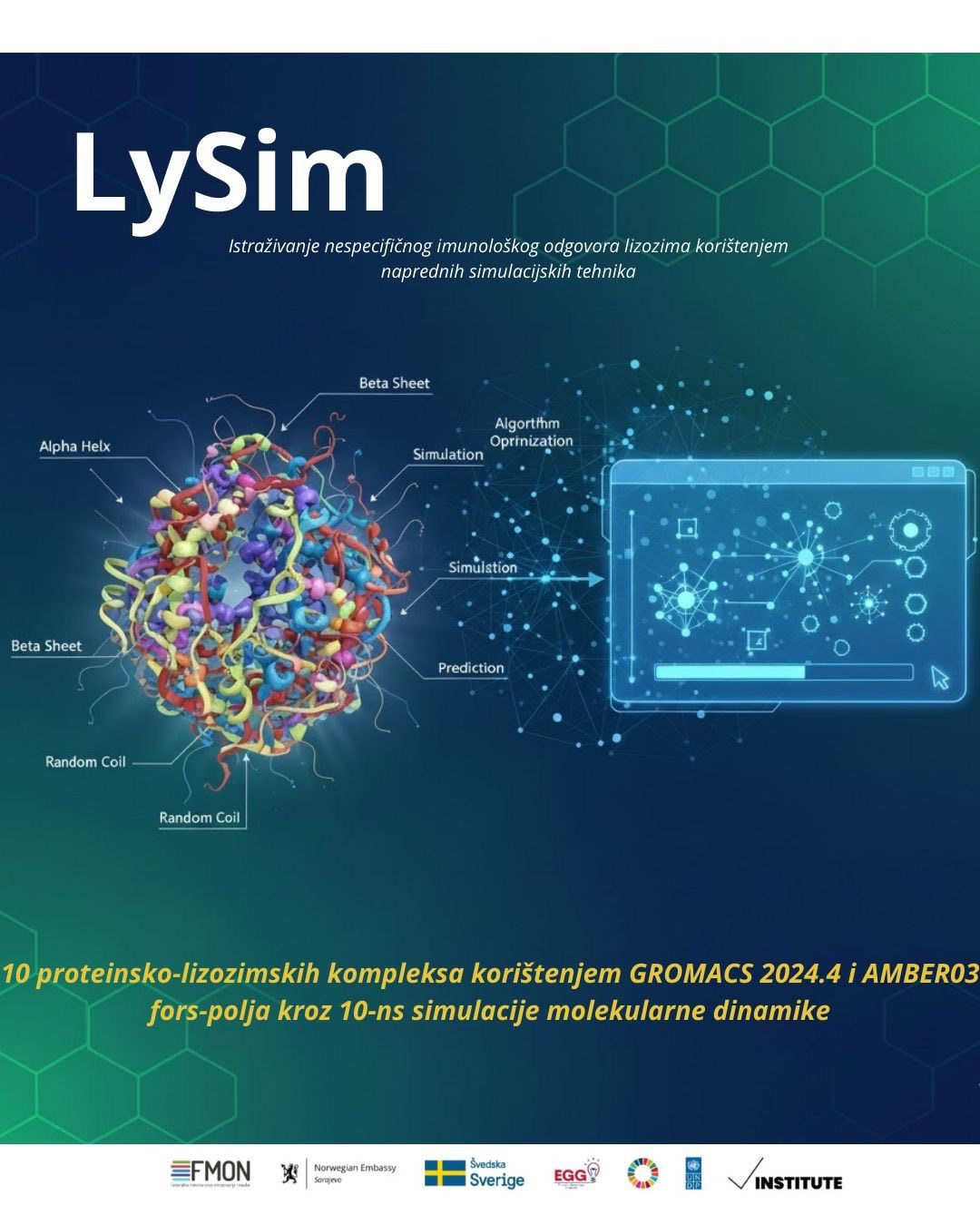
Faruk Bećirović, Sarah Spahić, Dr. Adna Ašić, Dr. Lemana Spahić
When Biology Moves into the Digital Space
At first glance, molecules seem to belong exclusively to laboratories, microscopes, and test tubes. In reality, their behavior is increasingly understood and predicted in the digital space. The reason is straightforward. Many processes in the human body occur on scales that are almost impossible to observe directly. This is where the digital domain comes into play, enabling us to simulate nature with exceptional precision through models in which physiological conditions are explicitly defined, such as temperature, acidity, pressure, and environmental composition. Molecules are then allowed to behave naturally, while the computer continuously records their changes. This approach makes it possible to anticipate molecular behavior, identify stable configurations, and detect potential points of failure in advance. This is not guesswork, but a numerical experiment grounded in the laws of physics and chemistry.
Today, we present the story of simulating the activity of the protein lysozyme. This scientific research was conducted by researchers from the Verlab Institute in collaboration with the company Bosnalijek, within an R&D grant scheme jointly funded by the Federal Ministry of Education and Science and the United Nations Development Programme (UNDP) in Bosnia and Herzegovina through the project “Improved Governance for Accelerated Economic Growth (EGG2),” financed by the Government of the Kingdom of Norway, as well as the program “Translating the Framework for the Implementation of the Sustainable Development Goals in BiH into Sustainable and Inclusive Growth (SDG2BIH),” funded by Sweden.
The guiding research question was straightforward: do lysozymes of different origins behave identically under physiological conditions?
Proteins as Systems, Not as Static Images
At every moment, millions of molecular “soldiers” move through our bodies. They are present in mucus, saliva, tears, and even breast milk, with a single mission: to protect us from pathogens that are ubiquitous in our environment.
If we imagine the body as a factory, proteins are the machines that keep the entire operation running. They drive chemical reactions, transport materials, transmit signals, and defend the organism against intruders.
In traditional approaches, proteins are often viewed as fixed structures. In reality, they are dynamic systems. Every atom moves, every bond oscillates, and these microscopic changes determine whether a protein will bind, react, or remain inactive.
The human immune system can be divided into two components. The first is the specialized component, antibodies that fight specific pathogens and develop after exposure through disease or vaccination. This is known as the specific immune response. The second component is a rapid-response force that attacks all potential threats without prior “training.” Lysozyme is part of this first line of defense, known in scientific terms as the nonspecific immune response.
To predict protein behavior, in this case lysozyme, it is necessary to calculate an enormous number of interatomic interactions over extremely short time intervals.
From Raw Data to Understanding
Scientific insights and simulations are only as good as the raw data used to build the models. For this reason, careful attention must be paid to data cleaning, optimization, and the precise assembly of molecular partners, much like a puzzle in which no piece can be misplaced.
Before simulations begin, the system must reach an energetically stable state in which molecules behave naturally, without artificial strain or collisions. This is a sensitive phase that requires sophisticated algorithms and significant computational power, particularly for large biomolecular complexes. Only after this step do the main simulations begin, those that generate scientifically relevant insights.
Within these simulations, we again addressed the central question: do lysozymes of different origins behave the same under physiological conditions?
Our models revealed how molecules approach one another, how they identify optimal binding positions, how much energy is required to form a bond, and which trajectories atoms follow as the system stabilizes. It is comparable to having a GPS for every atom in the system, complete with time stamps and a complete movement history.
A single simulation experiment generated millions of numerical values containing answers to key questions about protein function and the mechanisms of lysozyme activity. On their own, these values are not readable to the human eye. Through detailed analysis, however, they provide insight into protein interactions: how internal dynamics change at the moment each chemical bond forms, how one protein influences another, how conformational changes occur, and how the entire system transforms in real time toward a stable complex.
The result of a simulation is not an animation, but an enormous volume of numerical data. Only through careful analysis do these numbers acquire meaning. They reveal how a protein stabilizes, how it responds to its environment, and how reliable it is under conditions similar to those in the human body.
This is a level of insight that is not achievable through laboratory experiments alone, but becomes attainable when biology is integrated into a digital environment. At that point, simulation becomes a tool for understanding, and data become a narrative explaining how life functions at its most fundamental level.
Why Does This Matter?
Understanding these processes at the atomic level enables answers to questions that for decades required lengthy and expensive laboratory experiments. How effective is lysozyme from different sources? How exactly does it act on target molecules? Can its effectiveness be enhanced through changes in formulation, dosage, or application environment? Equally important, is there a risk of nonspecific reactions that could cause rashes, allergic responses, or hypersensitivity to therapy?
It is precisely at this level of detail that the in silico approach demonstrates its full value.
The results of the simulations enabled the generation of a range of quantitative and mechanistic insights, derived from detailed analysis of lysozyme behavior under simulated physiological conditions. These insights are not based on assumptions, but on numerically stable models and long-term dynamic simulations that faithfully describe molecular behavior.
For the industrial partner, such an in silico approach represents a valuable source of information that supports development and strategic decision-making.
- Simulations enable early identification of relevant molecular behavior patterns and the conditions under which specific effects can be expected, without the need for immediate laboratory testing.
- This approach significantly shortens the development cycle. Potential challenges can be identified at an early stage, before substantial resources are invested in experimental processes. Reliance on lengthy trial-and-error methods is reduced, and the focus shifts toward targeted optimization and efficient planning of subsequent steps.
- These results open the door to further, focused research under controlled conditions, with a clearer starting position and a deeper understanding of the system under investigation.
How Accessible Is This in Practice?
Attempting to observe the molecular world using a conventional computer would be like trying to record a slow-motion storm with a passport photo camera. There is simply not enough power, speed, or endurance. High-performance computing fundamentally changes this reality.
At first glance, this level of analysis may appear reserved for large international centers and multimillion-budget projects. In practice, modern computational infrastructure enables such calculations to be implemented as a shared resource rather than an individual investment.
For this project, the experimental research infrastructure of the Verlab Institute’s HPC system was used. As a result, the entire process, from system preparation to analytically usable results, was completed within a timeframe measured in weeks rather than months or years. The key advantage was the ability to execute the most demanding computational phases continuously, without interruptions or compromises in simulation resolution.
In this way, high-performance computing becomes a tool that enables industrial partners to pursue informed, rational, and time-efficient development without compromising data confidentiality or security.
At its core, HPC does not mean a single extremely powerful computer. It is an entire army of computing nodes, processors, and graphics accelerators working simultaneously in perfect coordination. A problem that would take a single computer days to solve is broken down by HPC into thousands of smaller tasks and executed in parallel. Each node computes a small part of the molecular system, while central mechanisms continuously exchange results, synchronize system states, and ensure that all parts of the simulation remain physically consistent. This is industrial-scale knowledge production in real time.