
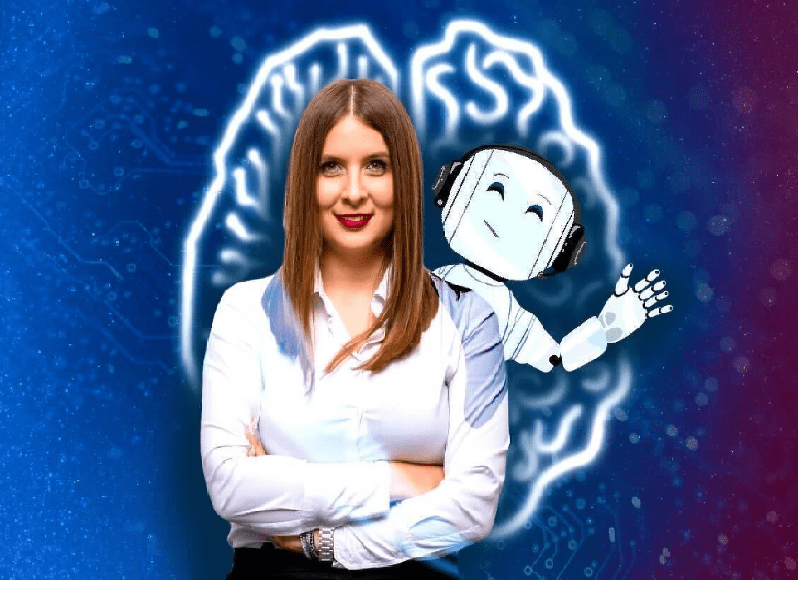
Lejla Gurbeta Pokvić is a young doctor of biomedical engineering, professor at the International Burch University and director of the Verlab Institute for Biomedical Engineering, Medical Devices and Artificial Intelligence. The focus of her work is improving health and quality of life with the help of artificial intelligence, so in Bosnia and Herzegovina she works on the development of support systems for specific diseases or management of medical devices.
Artificial intelligence is a big field of her scientific interest, so we contacted her to explain what artificial intelligence is, how it works, how it differs from humans and whether it can pose a danger to humanity.
How can artificial intelligence learn/acquire knowledge and can it be taught to judge or some other similar characteristics such as reason that are inherent in humans?
The word intelligence in the perception of today’s man is connected with the organ of the brain. That opinion also has a scientific foundation, given that it has been proven that everything that intelligence includes, and many other higher brain functions, such as consciousness, language and decision-making, can be characterized as a consequence of the developed cortex and prefrontal cortex of the cerebrum (Semendeferi et al. ., 2001), brain size, degree of encephalization, number and connectivity and conductivity of neurons (Roth and Dicke, 2005). Intelligence can be defined as a mental ability that, among other things, includes the ability to think, plan, think abstractly, solve problems, understand complex ideas, learn quickly and learn from personal experience. It reflects a broader and deeper ability to understand our surroundings and the environment.
Of course, intelligence and language are two characteristics that separate humans from other living creatures on Earth. People are able to think and critically evaluate the world around them and they are able to formulate these thoughts and communicate them with others, they are able to exchange ideas and work together to develop the world and make it a better place.
The term artificial intelligence (AI) was defined in the summer of 1956 at the Dartmouth University summer school. Scientists Minsky and McCarthy have described artificial intelligence as any task performed by a machine that would previously be considered to require human intelligence. Although the scientists who participated in defining the concept of artificial intelligence were very enthusiastic when it came to its development, in the period from 1974 to 1980, the field experienced a major failure due to a lack of financial resources. It started to grow again with investment from 1980, but experienced another winter from 1987 to 1993 due to the market collapse. After 1993, research accelerated, and in 1997, IBM introduced DeepBlue, a chess-playing machine that beat Gary Kasparov, the chess grandmaster. In 2011, Watson, a giant computerized answering machine, beat the Jeopardy quiz champions (Flasiński, 2016).
Ultimately, the definition of artificial intelligence is that it is a set of advanced tools that enable machines to sense, understand, act and learn (Moor, 2019). Artificial intelligence methodologies are developed on the basis of human intelligence and cognition and therefore cannot surpass the deductive reasoning and reasoning that the human mind can draw.
In order to characterize the relationship between natural and artificial intelligence, we can consider the human brain and artificial intelligence as a machine composed of hardware and software. The hardware of the human brain is a physiological entity located inside the skull that performs the functions of control, thinking and reflection. On the other hand, artificial intelligence hardware is a computer processor with associated software. Both hardware and software of artificial intelligence were developed by a human being with the goal of creating a machine capable of control, thought and deliberation.
What dangers can the products of artificial intelligence bring to humanity?
Humanity has always strived for development and empowerment. However, the technical limitations of the human body prevented this progress. Therefore, humans have developed mechanisms to circumvent these limitations in the form of artificial intelligence. Artificial intelligence does indeed encourage the development of human intelligence and extend it to capabilities that are unlikely to be achieved naturally. It is far more efficient than human intelligence in terms of calculation speed, accuracy and task capacity.
The prejudice against artificial intelligence and the controversies arising from its development are astounding and have made artificial intelligence a topic of concern for all people around the world. When engineers talk about artificial intelligence, they see it as a world of possibilities, progress and development of the modern world. However, when the general public talks about artificial intelligence, they see it as a threat. The biggest fear a person can have is the fear of the unknown and that is why people are generally afraid of artificial intelligence. They cannot perceive the scientific premises behind it and the principles on which it works. People think that artificial intelligence with its progress will develop consciousness and become independent and strive to conquer the world. These movie scenarios are unlikely to happen because artificial intelligence was developed by humans for the benefit of humans, not the other way around. Artificial intelligence cannot perceive the target of an operation, it only performs operations based on a set of instructions given to it by a human operator.
The age of artificial intelligence began as soon as the first spell-checking tools were available and the first Google search was implemented. Nowadays, artificial intelligence is effectively integrated into human practice in almost every imaginable aspect of life, starting from phones, cars, computers, through highly sophisticated virtual assistants such as Alexa or Siri, to medicine and household appliances.
What does a person need to know when talking to artificial intelligence?
AI is only as good as the data and algorithms it is trained on, so it may not have all the answers or understand the context of certain questions.
He works from premises assigned before the task begins and completes the task without any need to understand the purpose. This feature makes artificial intelligence superior to natural intelligence because no matter how much someone tries to separate themselves from emotions and compassion when making decisions, every person is prone to emotional investment in decisions.
Artificial intelligence is not capable of human emotion or consciousness, so it cannot understand sarcasm, irony or humor and may not respond in a way that is consistent with human expectations or moral principles.
How does Chat GPT work and what is its function? Does the benefit outweigh the harm (considering high schoolers will be using it so they don’t have to complete the assignments themselves)? How to distinguish human-written text from AI? How, for example, professors can deal with abuse of Chat GPT?
ChatGPT is a conversational language model developed by OpenAI. It is based on the GPT (Generative Pretrained Transformer) architecture and is trained on a large database of textual data from the Internet. The model uses this data to generate text (output) that is contextually relevant to a given query. ChatGPT can therefore be used for a variety of tasks, including chatbots, language translation and text completion. What ChatGPT really makes possible is that it can suggest things that a person doesn’t even think about at the time. However, even when analyzing the answers obtained through this tool, it should not be forgotten that this tool also works on the basis of the premises assigned before the start of the task and performs the task without any need to understand the purpose, so that the use of the results of this tool is entirely the responsibility of its user.
The topic of applying ChatGPT in the education system is hot these days. As for distinguishing text written by a human or ChatGPT, it is possible to use the GPTZero application. It’s another AI-based tool that can detect whether something is likely written by a human or ChatGPT.
Ultimately, the fact is that technology can be used by man as a tool to improve people’s lives, or as a weapon to completely destroy it, and therefore ethics appears as an important discipline that must not be separated from the application of artificial intelligence.
Therefore, regulators around the world are working to develop legal norms that will govern this area. In the European Union, work is currently underway to develop an artificial intelligence strategy that will ensure that artificial intelligence is directed for the benefit of humans and that it is reliable. excellence and trust through concrete rules and actions!
What direction is the world heading in when it comes to artificial intelligence? Can we expect them to become “extended arms of man” at some point? How will it be legally regulated?
Humanity must make a shift towards self-adaptive and self-optimizing processes instead of the commonly used ones.
The synergy of natural and artificial intelligence will improve the quality of life. Namely, artificial intelligence and natural intelligence face limitations in innovation processes and their synergism can lead to conceptual changes in how we perceive innovation. The interweaving of artificial and human intelligence in the performance of certain activities helps to circumvent challenges and bring innovation to a whole new level.
How is BiH progressing in the development of artificial intelligence?
The development of artificial intelligence and its application is recognized in the development strategy of the Federation of Bosnia and Herzegovina 2021-2027 1 . This measure includes the adoption of the FBiH artificial intelligence development strategy and the establishment of an artificial intelligence institute, as well as the determination of priority areas for the application of artificial intelligence, and is coordinated by the Federal Ministry of Transport and Communications. The report on the development of the Federation of Bosnia and Herzegovina in 2021, prepared by the Federal Institute for Development Programming, says that the strategy for artificial intelligence has not been adopted, nor has a platform for artificial intelligence been established.
Of the existing international indicators of the state of artificial intelligence, interesting data for Bosnia and Herzegovina are available in the form of the Artificial Intelligence Readiness Index of Oxford Insights. out of a total of 160 countries, in 2021, BiH is in 96th place. It is the worst position of all Eastern European countries. Of the other comparator countries, Slovenia is in 31st place, Serbia is in 52nd place, Croatia is in 61st place, Montenegro is in 75th place and North Macedonia is in 81st place. According to the authors of this index, the lack of an adequate innovation ecosystem for fostering VI skills and technologies, as well as stagnation of economic growth and brain drain, is responsible for such positions of countries that do not belong to the EU.
The scientific research institute Verlab for biomedical engineering, medical devices and artificial intelligence was established in 2021, with the aim of strengthening scientific research capacities aimed at the development and application of artificial intelligence in Bosnia and Herzegovina. In the past period, the Verlab Institute has established significant partnership relations with leading institutions in the field of artificial intelligence development, such as CERN and the Helm Holtz Institute, which will have a positive impact on the improvement of innovation and entrepreneurship, with the aim of attracting investments into the economy of Bosnia and Herzegovina.
The text is published as an article on the klix.ba portal: https://www.klix.ba/scitech/tehnologija/kako-se-vjestacka-inteligencija-razlikuje-od-ljudskog-mozga-i-da-li-zaista-moze-biti-opasna-po-covjeka/230214049?fbclid=IwAR2taVxHerKL52mW3BxWxYdJrTRRKEpf6a6oE88hn1boxSuJtSUwS2_7rqM